











LLMs in Healthcare Payers: Navigating the Hype Cycle
Large Language Models (LLMs) are AI systems trained on vast quantities of text to understand and generate human-like language.

Over the past year, the rapid evolution of large language models has triggered a wave of experimentation, investment, and strategic reevaluation across the payer ecosystem. What was once a theoretical concept has quickly become one of the most discussed opportunities in the industry. Nowhere is this shift more clearly illustrated than in Gartner’s newly released Hype Cycle for U.S. Healthcare Payers.
Gartner released its annual Hype Cycle for U.S. Healthcare Payers, offering a snapshot of how emerging artificial intelligence technologies are evolving in the industry. One standout: Large Language Models (LLMs) for Healthcare Payers have officially reached the Peak of Inflated Expectations. For healthcare organizations exploring generative AI solutions, this moment marks both opportunity and caution. But what does that mean for payers eyeing generative AI tools?
Below, we explore where LLMs sit on the hype cycle, examine the drivers behind their accelerated rise, highlight the risks that may emerge over the next 12–18 months, and offer a detailed roadmap for how healthcare providers and payers can strategically prepare for the future of healthcare. We also take a broader look at LLMs in healthcare and how emerging architectures, governance patterns, and AI systems fit into long-term transformation strategies.
What Are LLMs for Healthcare Payers?
Large Language Models (LLMs) are AI systems trained on vast amounts—including medical literature, clinical notes, and payer documentation—of text to understand and generate human-like language. These models are capable of understanding and generating human language using sophisticated natural language processing capabilities. The potential for LLMs in healthcare goes far beyond simple chat interfaces. Modern enterprise architectures allow LLMs to summarize complex documents, interpret structured and unstructured data, answer policy questions, support healthcare professionals, or even initiate downstream system actions through agentic patterns.
When deployed responsibly, large language models can support or automate a wide range of administrative tasks and payer operations.
For healthcare payers, LLMs unlock potential across a wide range of use cases, including:
- Automating prior authorizations
- Streamlining provider communication
- Enhancing patient engagement and education
- Improving clinical workflows
- Summarizing clinical documentation and complex medical histories
- Simplifying claims intake and review
- Extracting insights from medical data and structured and unstructured clinical documents
- Supporting call center staff through guided decision flows
- Creating explainable summaries for compliance review
- Assisting in early fraud, waste, and abuse detection by identifying anomalies
Each of these use cases supports targeted gains in operational efficiency while reducing administrative strain. Yet despite the promise, implementation in healthcare organizations remains complex and dependent on strong governance practices, careful measurement, rigorous evaluation, and a thoughtful approach to data privacy. One of the more mature examples of that pattern already in production is AI summarizing doctor-patient conversations privately, which shows what a narrowly scoped, high-volume use case looks like once it clears the hype. Research teams are seeing a similar arc, using private LLMs to accelerate literature triage and protocol drafting in medical research workflows long before the technology reaches a payer's plateau of productivity.
Where LLMs Stand on the 2024 Hype Cycle
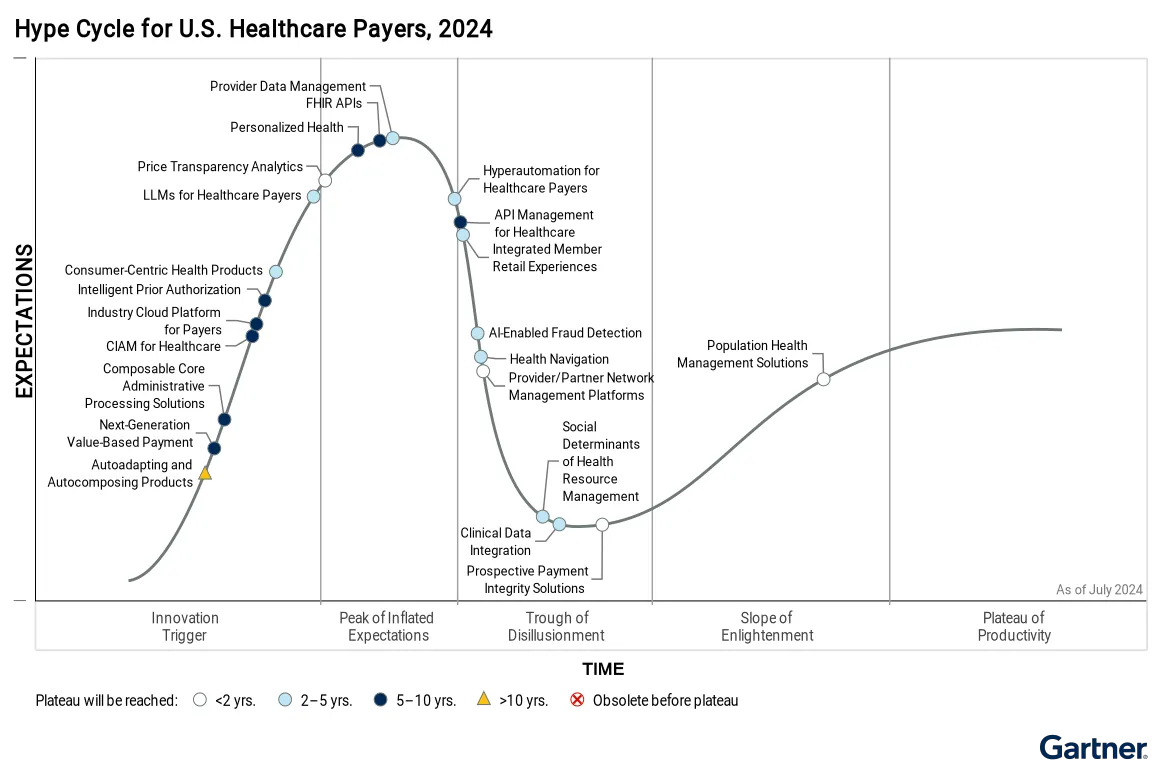
Source: Gartner, 2024 Hype Cycle for U.S. Healthcare Payers
In this year’s chart, Gartner places LLMs for Healthcare Payers at the Peak of Inflated Expectations, indicating widespread enthusiasm and elevated expectations that often surpass what current from-scratch artificial intelligence implementations can achieve. This phase is characterized by exciting early demos, significant vendor hype, and a growing library of innovation pilots—many of which are still too early to reflect production-grade performance.
Early demos show strong potential, but translating those results into enterprise-scale deployments remains challenging due to concerns around governance, interoperability, accuracy, and long-term ROI.
Understanding the Hype Cycle Curve
Here's a breakdown of where LLMs sit in comparison to other technologies:
| Hype Cycle Phase | Technologies | LLMs Included? | Typical Challenges |
|---|---|---|---|
| Innovation Trigger | CIAM for Healthcare, Composable Core Admin Solutions | No | Unproven viability, early experimentation |
| Peak of Inflated Expectations | LLMs for Healthcare Payers, Personalized Health, FHIR APIs | Yes | Unrealistic projections, pilot overreach |
| Trough of Disillusionment | AI-Enabled Fraud Detection, Clinical Data Integration | No (expected soon) | Failures to deliver ROI, skepticism grows |
| Slope of Enlightenment | Population Health Management Solutions | No | Best practices emerge, adoption increases |
| Plateau of Productivity | (Not yet reached for LLMs) | No | Widespread, proven ROI |
Here’s how LLMs compare to other emerging technologies on the same curve:
- Price Transparency Analytics
- FHIR APIs supporting interoperability
- Personalized Health technologies powering more tailored treatment plans
- Tools that improve efficiency across payer workflows
LLMs sit above many of these innovations, primarily because widespread public exposure to generative AI has accelerated expectations.
Why LLMs Are Peaking Now
LLMs like ChatGPT and Claude have reshaped public and professional conversations about automated decision making, patient care, and generative AI. In healthcare, rising operational costs, staffing challenges, and pressure for better outcomes have made AI-powered automation appealing.
Key factors behind the current buzz:
- Open-source and commercial AI models (e.g., MedPalm, ClinicalBERT) tailored to healthcare
- Surge in venture capital and healthtech innovation
- Integration into enterprise tools (e.g., Epic’s use of GPT models in EHRs)
- Expansion of machine learning infrastructure across health plans
- Increased spending on automation to enhance patient outcomes
These developments reflect both the potential and the volatility inherent in deploying LLMs in healthcare.
Next Stop: The Trough of Disillusionment
If history holds, the next 12–18 months may bring challenges as organizations begin to use LLMs more in healthcare. Expect to hear about:
- Compliance with HIPAA and protection of data privacy
- Concerns over hallucinations and inaccurate outputs affecting clinical decision support
- Lack of interoperability with legacy healthcare systems
- Challenges proving ROI in real-world settings
- Limitations in interpreting clinical notes and complex medical contexts
- Overly optimistic automation claims not holding up in production
These issues do not signal a failure of large language models—only that the technology is ahead of operational readiness in many organizations. In most payer environments, governance, fine-tuning, and enterprise controls lag far behind the model capabilities themselves.
Strategic Guidance for Payers
LLMs are not plug-and-play tools. But with thoughtful preparation, payers can achieve meaningful gains in efficiency and patient support workflows.
Here’s a checklist to guide strategic deployment:
- Start with narrowly scoped, high-volume tasks (e.g., claims Q&A or summarizing clinical documentation)
- Implement Model Context Protocol (MCP) or similar governance frameworks to maintain strict security
- Adopt human-in-the-loop oversight to ensure quality in decision support
- Avoid vendor lock-in by considering interoperable AI-powered LLM platforms
- Monitor regulatory shifts (e.g., HIPAA-compliant AI-assisted from and use of data)
These steps help ensure LLMs enhance operations without compromising compliance or the integrity of patient care.
Related Tech to Watch
LLMs aren’t the only tech reaching the Peak. Others include:
- Price Transparency Analytics – Driven by CMS mandates
- FHIR APIs – Enabling interoperability across systems
- Personalized Health – Fueling predictive care and engagement that tailor treatment plans and boost patient outcomes
- Automation tools that increase operational efficiency
- Enhanced patient experience platforms supporting engagement
These innovations complement the rise of large language models and shape how healthcare organizations plan for long-term digital transformation.
When Will LLMs Reach Productivity?
Gartner estimates that LLMs for Healthcare Payers are 5–10 years away from reaching the Plateau of Productivity.
Factors that will accelerate this timeline include:
- Rigorous validation in healthcare settings
- Consistent measurement using domain-specific LLM metrics
- Wider adoption of secure, private deployments fine-tuned on payer-specific documentation
- Better alignment with workflows used by healthcare professionals and healthcare providers
- Expansion of high-quality domain-specific datasets
The next phase will require disciplined investment and organizational maturity rather than hype-driven experimentation.
Where We Might Be in 2026
By 2026, we anticipate:
- A shakeout of vendors—only the LLMs that deliver true value will survive.
- Hybrid deployments, where private LLMs ingest organization-specific data securely.
- Greater interest in agentic AI, where LLMs don’t just generate responses but take actions within clinical workflows.
If executed well, LLMs in healthcare could become foundational to payer operations.
FAQ: LLMs in Healthcare Payers
Q1: Are LLMs HIPAA-compliant?
A: Not inherently. Compliance depends on how the model is hosted, what data is processed, and whether proper safeguards (e.g., de-identification, audit logging, data privacy frameworks) are in place.
Q2: What’s the difference between a general LLM and a healthcare-specific one?
A: Healthcare-specific LLMs are trained on clinical notes and healthcare documentation, enabling higher accuracy for domain-specific medical queries.
Q3: Can I use an LLM to replace my support staff?
A: Not today. LLMs can assist with repetitive, administrative tasks, support decision making, and improve patient care, but require human oversight for complex and regulatory-sensitive interactions.
Q4: Is it better to build or buy an LLM solution?
A: For most payers, buying a pre-built, fine-tuned model (with options to customize) is more cost-effective than developing custom artificial intelligence models in-house.
Q5: How do I evaluate LLM performance?
A: Use benchmarks like EMR accuracy, claims processing speed, clinical decision support quality, compliance audits, and user satisfaction scores. Don’t rely on token or word count metrics alone.
Timothy Carter is the Chief Revenue Officer. Tim leads all revenue-generation activities for marketing and software development activities. He has helped to scale sales teams with the right mix of hustle and finesse. Based in Seattle, Washington, Tim enjoys spending time in Hawaii with family and playing disc golf.


Bringing AI in-house, the right way.
Talk through your private or on-prem LLM deployment with an expert who has shipped them in regulated environments.
Private AI, in your inbox.
Occasional, high-signal notes on enterprise LLM deployment, security, and model strategy. No spam.