LLM Appliance vs Self-Built GPU Cluster for Private AI
Compare a turnkey LLM appliance against a self-built GPU cluster on cost, staffing, compliance, and time to production, with a clear decision framework.

Most private LLM procurement conversations start with a spec sheet and end in a spreadsheet. The spreadsheet is where the trouble begins. Two paths look superficially equivalent on the capital line: buy a rack of GPUs and stand up your own inference cluster, or take delivery of a pre-integrated LLM appliance that arrives on a pallet with the model, serving stack, and audit tooling already wired together. Both give you weights you own and a perimeter you control. Neither gives you the same operating model, staffing burden, or time-to-first-token.
This is the head-to-head buyers actually face once they have ruled out public APIs. The self-built cluster is the flexible, higher-ceiling option. The appliance is the faster, narrower one. Choosing between them is less about hardware and more about how much of the platform your team wants to own versus operate as a supported product.
What Each Path Actually Delivers
A self-built GPU cluster is a stack you assemble: chassis, accelerators, NVLink or InfiniBand fabric, storage, a Kubernetes or Slurm control plane, an inference runtime like vLLM or TensorRT-LLM, plus the model weights, guardrails, RAG pipeline, and audit logging you glue on top. NVIDIA's DGX BasePOD is the canonical reference design at the small end; a SuperPOD is the same idea at multi-rack scale. You get maximum flexibility and no vendor abstractions, and you sign up to run every layer.
An enterprise AI appliance collapses most of that into a supported SKU. A LLM appliance arrives with a validated model, the serving stack, an admin console, RBAC, and audit logging bonded to hardware you can drop into a rack or a secure closet. You lose some flexibility, particularly around exotic model architectures or bespoke fabric topologies. You gain a single throat to choke and a deployment window measured in days rather than quarters.
The core distinction is not the silicon. Both paths run the same accelerators. The distinction is where the integration boundary sits, and therefore which team owns which failure mode.
Pricing the Two Paths Honestly
Sticker prices for GPU servers in 2026 are within a narrow band. A fully configured 8-GPU DGX H200 system runs $400,000 to $500,000, and an 8-GPU HGX B200 server quotes around $450,000 when you can secure allocation. Those numbers are the floor for the hardware itself. They exclude networking uplift, high-performance storage, rack power distribution, and cooling retrofits.
The self-built path adds a construction budget on top. A single node draws real power: eight H100 GPUs alone consume over 5.6 kilowatts, and once CPUs, NICs, and cooling overhead are added, node draw pushes past 10 kW. Most colo cages and enterprise data halls were provisioned for 4–8 kW racks. Densification, PDU upgrades, and rear-door heat exchangers are line items that rarely appear in the initial GPU quote.
An appliance path shifts that cost into a bundled quote. The vendor absorbs the integration and validation labor, ships a system pre-burned with drivers, CUDA, serving runtime, and the guardrail policy, and typically prices support as an annual attach. The unit cost per GPU is usually higher than raw hardware; the delivered cost of a running, audited system is often lower once implementation labor and calendar time are included.
The Hidden Operating Costs Nobody Quotes
The most predictable underestimate in any private LLM plan is the staffing line. A GPU cluster running production inference generally requires 0.5–1 FTE per cluster for driver management, hardware failures, firmware updates, and cluster operations. That is before you factor in the ML engineers who own the model itself, the platform engineers who own the serving layer, or the security team who owns the audit pipeline. A mid-level MLOps engineer in the US costs about $135,000 per year fully loaded, and there are usually two of them by year two so the on-call rotation is survivable.
The other underestimate is procurement calendar. GPU procurement lead times in 2026 still run 2–6 weeks for H100 SXM5 servers, and Blackwell allocation continues to favor hyperscalers over enterprise buyers. If your project has a hard go-live date tied to a regulatory deadline or a customer commitment, calendar risk is a real cost even when it never appears in the TCO model.
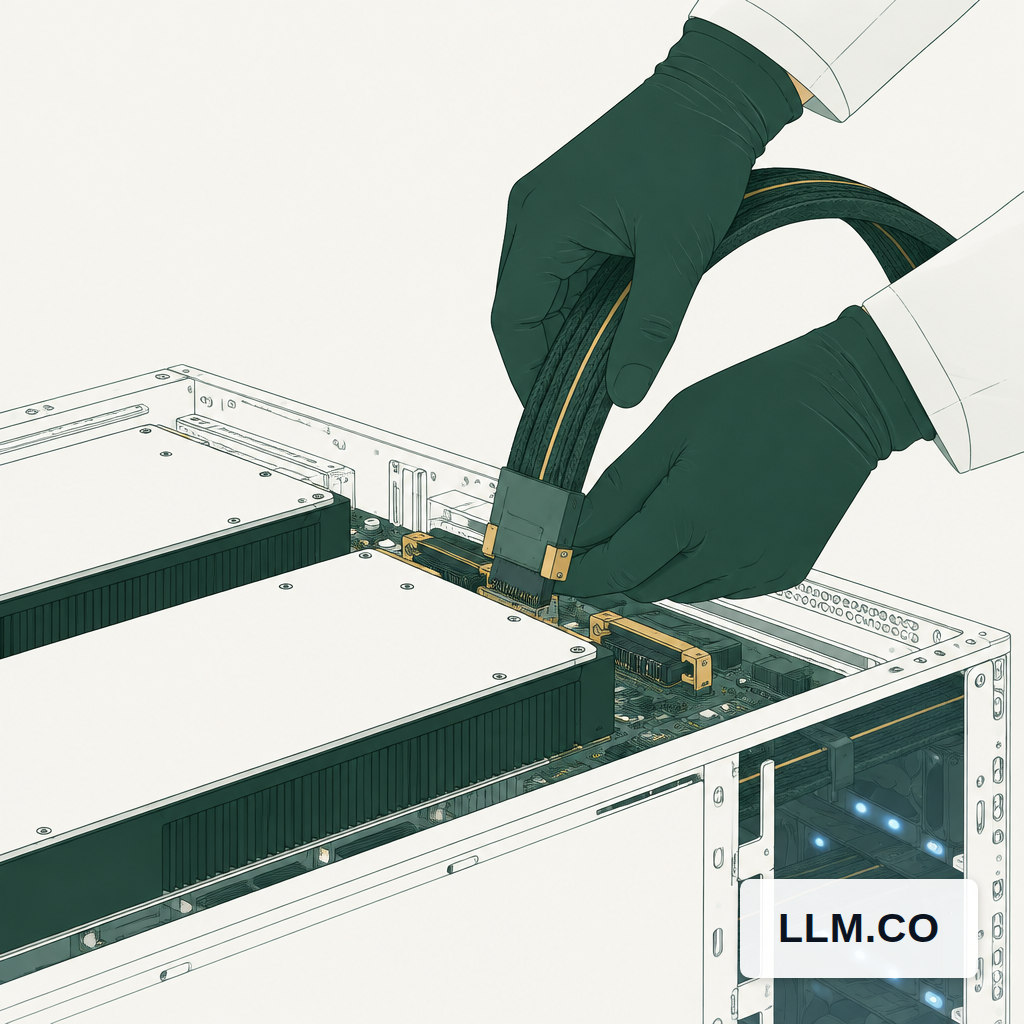
Utilization is the third silent variable. Independent break-even work converges on the same rough answer: a self-built on-prem cluster starts to beat cloud rental at roughly 80%+ sustained GPU utilization over a three-year horizon. Below that threshold, idle GPUs are the most expensive line in the budget. We have written about this pattern before in the context of GPU lock-in, and it holds here: the appliance model is more forgiving of variable load because the vendor sizes and refreshes the box against your actual throughput.
Which Regulatory Conditions Push You Each Way
Data sovereignty rules do not automatically favor one path. Both a well-run cluster and a well-built appliance can satisfy the location, deletion, and access-control requirements in HIPAA, GLBA, GDPR, and the NIST AI Risk Management Framework. The differences show up in evidence generation.
Appliances usually ship with audit logging, model version pinning, and access controls that a compliance team can point at during an assessment without commissioning custom work. That maps well to organizations pursuing SOC 2 Type II or working through the kind of documentation load discussed in our post on AI compliance frameworks. Self-built clusters can produce the same evidence, but the audit trail is something your team builds, tests, and maintains through every firmware and model update.
Two regulatory patterns push toward the cluster. First, if your regulator or customers require you to demonstrate model-level control that is genuinely bespoke, such as unusual data residency partitions, custom differential privacy at inference time, or a training pipeline you must inspect end-to-end, an appliance abstraction may get in the way. Second, if you already have an accredited high-side environment with existing GPU compute and a mature platform team, the cluster path lets you extend a control envelope you already own.
Two patterns push toward the appliance. A federal or state agency operating under FedRAMP-adjacent rules often benefits from a supported system whose components have documented provenance. A regional bank, hospital network, or law firm without a dedicated ML platform team benefits from moving faster than the hiring cycle allows.
A Decision Framework You Can Defend
The buy-versus-build question yields to a small number of concrete inputs. The chart below sequences them.
Two staffing conditions dominate. If you already run a platform engineering team that owns Kubernetes, storage, and observability in production, adding a GPU cluster is an incremental capability. If you do not, standing one up will pull two to four senior hires into a hiring market where those people are expensive and slow to close.
Two workload conditions dominate the economics. Sustained utilization above roughly 80% and a three-year horizon favor ownership of raw hardware. Bursty or exploratory workloads favor the appliance, because you are paying for a supported service rather than the depreciation curve of idle silicon. Our note on AI cost predictability covers the shape of that curve in more detail.
The last input is calendar risk. If a regulator, customer commitment, or board deadline forces a live private deployment within a quarter, the appliance path is usually the only credible option because GPU allocation, data center changes, and platform hiring do not fit inside 90 days.
Sizing the Right Answer for Your Environment
Neither path is universally correct, and framing it as a binary usually obscures the real question. Many regulated deployments end up hybrid: an appliance handles the primary production workload and produces the audit evidence, while a smaller research cluster serves fine-tuning experiments and model evaluation. That split keeps the compliance surface small, isolates experimentation from production SLAs, and avoids the trap of running the whole program at the mercy of one procurement cycle.
Whatever the split, the discipline is the same. Price the delivered system, not the hardware. Staff the platform, not the pilot. Choose the integration boundary that matches the team you actually have. The appliance and the self-built cluster are both defensible answers, and the wrong one is the one you picked without pricing the other.
Nate Nead is the founder and CEO of Marketer, a distinguished digital marketing agency with a focus on enterprise digital consulting and strategy. For over 15 years, Nate and his team have helped service the digital marketing teams of some of the web's most well-recognized brands. As an industry veteran in all things digital, Nate has founded and grown more than a dozen local and national brands through his expertise in digital marketing. Nate and his team have worked with some of the most well-recognized brands on the Fortune 1000, scaling digital initiatives.


Bringing AI in-house, the right way.
Talk through your private or on-prem LLM deployment with an expert who has shipped them in regulated environments.
Private AI, in your inbox.
Occasional, high-signal notes on enterprise LLM deployment, security, and model strategy. No spam.