





Private LLM vs ChatGPT Enterprise on Cost, Security and Performance
A side by side look at ChatGPT Enterprise and a self-hosted private LLM across total cost, data handling, compliance posture, latency and model performance.

Most CIO conversations about enterprise AI start with the same assumption: ChatGPT Enterprise is the default, and anything else is a special case to justify. In practice, the decision is narrower. It comes down to whether your data can leave your administrative boundary, what you are willing to pay per seat for a managed frontier model, and whether an open-weight model running on your own GPUs is close enough on the tasks your users actually run.
This piece lines up ChatGPT Enterprise against a private deployment of a Llama 3.3, Qwen 2.5, or Mistral class model on three axes: cost, security, and performance. Figures are for 2026 and reflect reported, not official, pricing on the OpenAI side. The point is to give a committee one reference document rather than three.
What Each Side Actually Is
ChatGPT Enterprise is a managed SaaS workspace on OpenAI infrastructure, sold through sales with custom pricing. OpenAI's launch page describes the product; the buyer never touches the model weights, the inference stack, or the storage layer. Admins get SSO, SCIM, a Compliance API, data residency selection, and optional Enterprise Key Management.
A private LLM, in the sense this site uses it, is an open-weight model (commonly Llama 3.3 70B, Qwen 2.5 72B, or Mixtral 8x22B) served on hardware your organization controls: a colocated GPU cluster, an on-prem rack, or a VPC you own. Inference, logging, retrieval, and fine-tuning all live inside your boundary. The reference architecture is covered in deploying an open-weight LLM and the LLM Appliance product page.
Cost at 200 and 2,000 Seats
OpenAI does not publish a ChatGPT Enterprise price. Reporting across procurement blogs in 2026 converges on a typical rate of roughly $60 per seat per month inside a $45-$75 range, a ~150-seat minimum, and annual prepay, with reported 2026 bands of $55-60 at 150-999 seats, $48-55 at 1,000-4,999, and $40-48 at 5,000+.
At 200 seats, a midpoint $57 rate is roughly $136,800 per year, or about $410,400 over three years before any Compliance API, extra credit, or additional model usage. At 2,000 seats, a $51 midpoint is about $1.22M per year, or roughly $3.67M over three years. Volume discounts and shared credit pools can move those numbers, but a 150-seat floor and annual commitment are the shape every buyer should assume.
On the private side, the dominant line items are GPUs, power, colocation, and MLOps staff. A fully built 8x H100 SXM5 node runs in the $250K-$400K range for hardware alone, with a three-year TCO of roughly $350K-$450K in hardware depreciation plus about $10,500 a year in electricity at $0.12/kWh and ~30% more for cooling. Our own GPU cluster cost breakdown for 200 users and the line-by-line private AI breakdown go deeper on what actually hits the invoice.
For a 200-seat Llama 3.3 70B deployment with reasonable concurrency, a single 8x H100 node plus a smaller standby node is a defensible starting point. Three-year TCO at that scale typically lands between $600K and $900K all in: hardware, power, colocation, networking, one or two MLOps engineers, and software support. That is in the same order of magnitude as 200 ChatGPT Enterprise seats, with the ratio inverting as you add users. At 2,000 seats, the same cluster scaled to three or four nodes stays well under half of the ChatGPT Enterprise three-year number.
The pattern is familiar: SaaS wins on time to first prompt, private wins on marginal cost per seat once the fleet is loaded. The crossover is a utilization problem, not a sticker-price problem.
Security and Data Flow Differences That Matter
ChatGPT Enterprise ships with real controls: AES-256 at rest, TLS 1.2+ in transit, SOC 2 Type II, ISO/IEC 27001, SAML SSO, SCIM, admin-set retention, a Compliance API, and optional Enterprise Key Management. OpenAI contractually commits not to train on business data, and offers a Business Associate Agreement for healthcare customers. The admin controls reference catalogs the current surface.
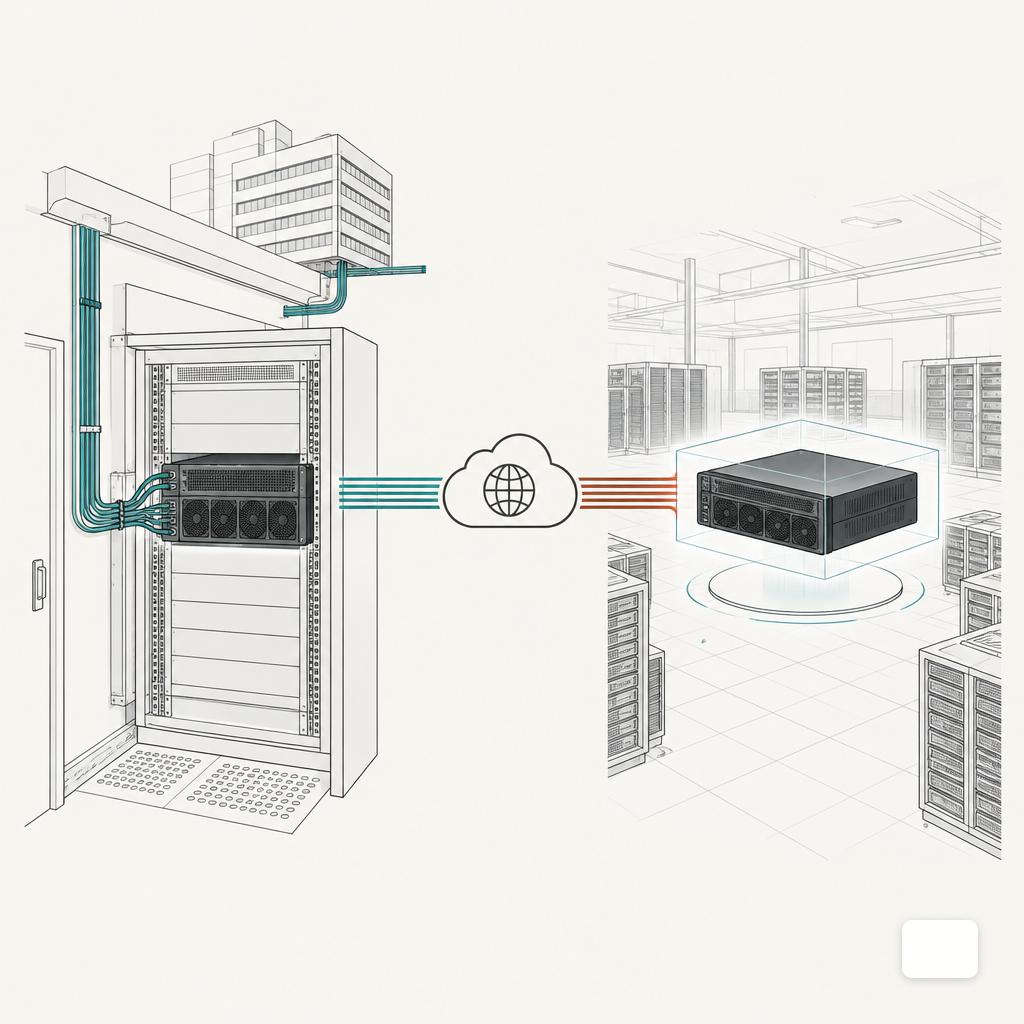
What those controls do not change is the data flow. Prompts, file uploads, and tool-call payloads leave your network, traverse OpenAI's infrastructure, and are stored according to your retention policy inside their tenancy. EKM protects stored ciphertext but not the inference path, and audit evidence comes from OpenAI's Compliance API rather than from your own request boundary. For many enterprises that is acceptable. For a law firm under privilege, a hospital under HIPAA, a bank under GLBA, or a defense contractor under CMMC 2.0 Level 2, it often is not. The compliance tradeoffs are mapped in more detail in this walkthrough of SOC2, HIPAA, and GDPR.
A private deployment inverts the diagram. Prompts never leave the VPC or the physical rack. Audit logs land in your own SIEM (Splunk, Sentinel, Elastic) with your retention policy, not a 90-day minimum set by a vendor. Keys live in your HSM. Network egress can be blocked entirely for an air-gapped build. EU AI Act conformity assessments, discussed in this walkthrough, are easier to pass when the system boundary stops at your firewall.
Performance: Open Weights vs GPT-4 Class
The honest answer is that frontier closed models still lead on broad reasoning benchmarks, and the gap on narrow enterprise tasks is often small to zero. On published MMLU scores, Llama 3.3 70B lands at about 86.3% and Qwen 2.5 72B at about 86.8%, against GPT-4o at 88.7% and GPT-4 Turbo at 86.5%. Newer GPT-5 class models score higher still, in the low to mid 90s.
- 1Llama 3.3 70B
- 2Qwen 2.5 72B
- 3GPT-4 Turbo
What matters for a committee is the delta on tasks that resemble production work: document extraction, retrieval-grounded Q&A, code generation, classification, and summarization. On HumanEval, Llama 3.3 70B scores around 88% and matches or exceeds many closed baselines on coding. For retrieval-heavy workloads, model quality is usually not the bottleneck; the RAG pipeline and the chunking strategy are. A fine-tuned Mistral or Llama on your own corpus will frequently beat a general-purpose frontier model on domain-specific QA, which is the point most private LLM case studies make.
Latency and throughput are the other half of performance. On an 8x H100 node, vLLM serves Llama 3.1 70B at roughly 2,800 tokens per second aggregate, which supports hundreds of concurrent users at interactive latencies when batching is tuned. ChatGPT Enterprise latency depends on OpenAI's load and routing, which you cannot see or control.
How to Decide Without Picking a Religion
The question is rarely "which is better." It is which of your workloads belong on which stack. Three practical screens:
- Data sensitivity. If a workload touches PHI, privileged client matter, CUI, or material non-public financial data, the default should be private. Everything else is negotiable.
- Seat count and utilization. Under 150 seats and intermittent usage, ChatGPT Business or Enterprise is hard to beat on time to value. Above 1,000 seats with sustained utilization, private economics pull ahead, especially once you add agents, batch jobs, and overnight pipelines.
- Audit surface. If your auditors need SIEM-side evidence of every prompt, response, and tool call, a vendor-supplied Compliance API is a weaker position than owning the log stream.
Most of the regulated enterprises we work with end up running both: a private cluster for sensitive and high-volume workloads, with ChatGPT Business or Enterprise seats for a smaller group that benefits from the frontier model. The migration pattern is predictable once the committee agrees on which workloads sit where.
What to Put in Front of the Committee
The deliverable is not a verdict. It is a two-column table with cost, data flow, compliance mapping, and benchmark expectations for both options, scaled to your actual seat count and workload mix. ChatGPT Enterprise is a credible choice for a lot of general-purpose work. A private deployment is the right choice when the data cannot leave, when the seat count and utilization justify owning the stack, or when the audit evidence has to come from your side of the wire. Pretending there is one answer is the thing to avoid.
Throughout his extensive 15+ year journey as a digital marketer, Sam has left an indelible mark on both small businesses and Fortune 500 enterprises alike. His portfolio boasts collaborations with esteemed entities such as NASDAQ OMX, eBay, Duncan Hines, Drew Barrymore, Price Benowitz LLP, a prominent law firm based in Washington, DC, and the esteemed human rights organization Amnesty International. In his role as a technical SEO and digital marketing strategist, Sam takes the helm of all paid and organic operations teams, steering client SEO services, link building initiatives, and white label digital marketing partnerships to unparalleled success. An esteemed thought leader in the industry, Sam is a recurring speaker at the esteemed Search Marketing Expo conference series and has graced the TEDx stage with his insights. Today, he channels his expertise into direct collaboration with high-end clients spanning diverse verticals, where he meticulously crafts strategies to optimize on and off-site SEO ROI through the seamless integration of content marketing and link building.


Bringing AI in-house, the right way.
Talk through your private or on-prem LLM deployment with an expert who has shipped them in regulated environments.
Private AI, in your inbox.
Occasional, high-signal notes on enterprise LLM deployment, security, and model strategy. No spam.