







SLA, Security, and TCO in Managed vs Self-Run GPU Hosting
Compare managed private LLM hosting against self-managed GPU servers across SLA uptime, security controls, incident response, and three-year total cost of ownership.

A 99.9% monthly uptime SLA allows about 43 minutes of downtime every month, and the credits it pays refund the hours that failed, not the revenue or regulatory exposure those minutes cost. That shortfall between credited hours and actual losses is where the real contract fight lives in private LLM hosting.
Three dimensions decide most managed-vs-self-run negotiations: SLA clause language, the shared-responsibility matrix for security, and a three-year total cost of ownership that counts the items buyers routinely miss. Our earlier comparison framed the tradeoff at the strategy level; the clauses below are where signatures actually land.
What SLA Credits Actually Compensate
Service credits are a refund metric, not an indemnity. Amazon Bedrock's published SLA pays a 10% credit when monthly uptime falls between 99.0% and 99.9%, 25% between 95.0% and 99.0%, and 100% only when uptime drops below 95.0%. Below 95.0% is more than a full day of outage per month, by which point most regulated LLM workloads have already escalated to incident review regardless of the credit.
For a self-run cluster, the "SLA" is whatever the infrastructure team commits in writing to the business. The number has to be defensible from the hardware, not aspirational. A single-node inference tier on one H100 pod with no failover is unlikely to sustain 99.9%; three-nines on a regulated deployment typically needs redundant inference nodes, a tested failover path, and 24x7 on-call coverage.
Three clauses matter more than the headline number:
- Scope of measurement. What counts as "down": control-plane errors only, or latency past a P95 target? LLM traffic often degrades well before it fails.
- Exclusions. Scheduled maintenance, emergency patching, regional events, and customer-caused issues can absorb most of the error budget. The 2024 CrowdStrike cascade was formally excluded from many cloud SLAs.
- Remedy cap. Credits are almost always capped at a percentage of the monthly fee for the affected service, never the business impact.
Where the Security Responsibility Line Moves
The shared-responsibility model is where most managed-vs-self-run disputes resolve. Gartner has predicted that through 2025, 99% of cloud security failures will be the customer's fault, driven overwhelmingly by misconfiguration. That share does not change when a buyer moves to a managed LLM; it reshuffles which misconfigurations are theirs.
In a managed deployment the provider owns the physical plant, hypervisor and base runtime; the customer still owns IAM, prompt logging, data classification, retention and model-level guardrails. In a self-run deployment the customer owns all of it, including firmware cadence and the audit log destination. Neither posture is inherently more compliant; the audit evidence simply lives in different hands. Our LLM security audit practice assesses that handoff from both sides.
- 1Scoping and readiness assessment
- 2Gap analysis against Trust Services Criteria
- 3Remediation of identified gaps
- 46-12 month observation period
- 5Auditor evidence testing
- 6Type II report issuance
- 7Annual recertification
Attestation adds its own schedule. SOC 2 Type II is not a snapshot: the auditor observes controls over a sustained window and reissues the opinion annually. A managed provider amortizes that effort across its customer base; a self-run operator pays it directly but also controls scope and evidence.
A Line-Item Three-Year TCO
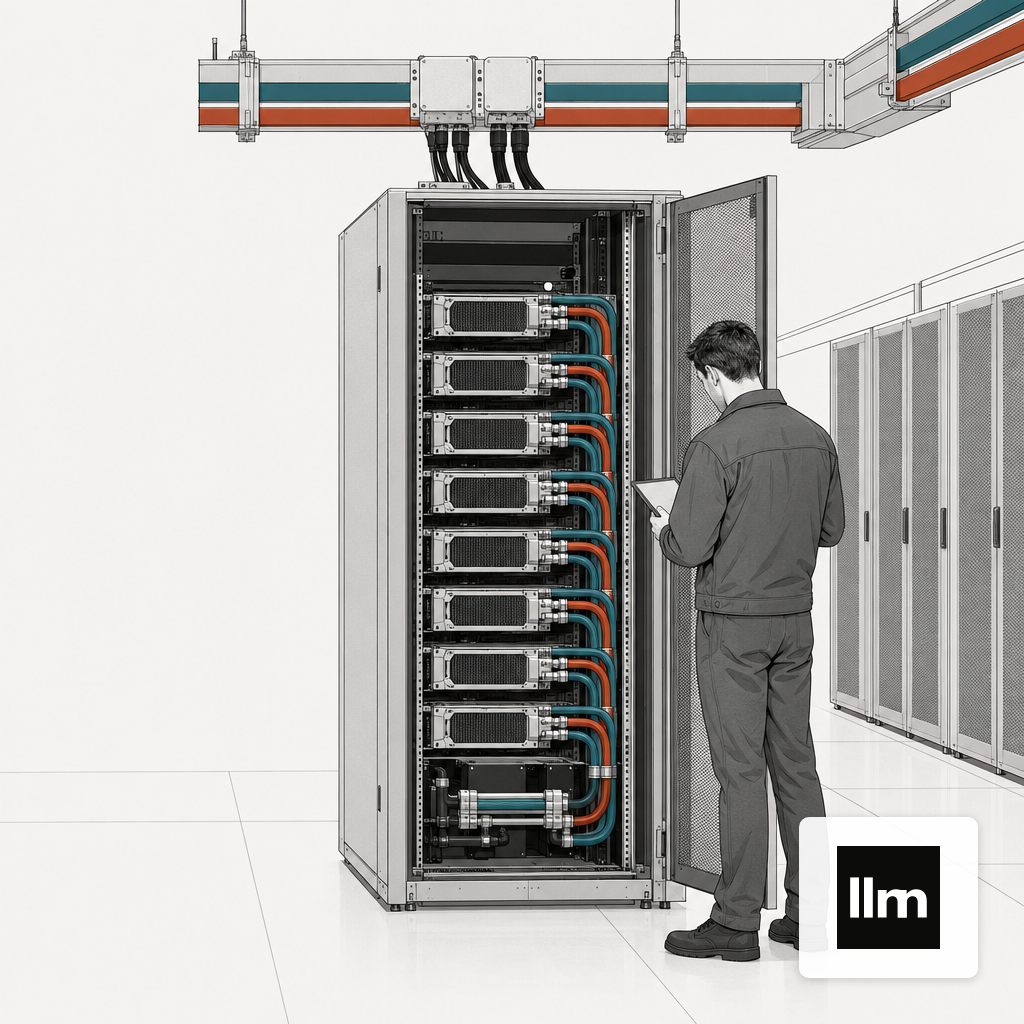
Published AWS on-demand pricing for an H100 instance now sits near $6.88 per GPU-hour after a 44% cut in June 2025. Reserved and savings-plan rates discount further. An eight-GPU H100 node at on-demand, run 24x7, lists at roughly $482,000 per year, or about $1.45M over three.
Self-run comparisons have to include the items that disappear into a managed invoice. Our GPU cluster cost breakdown treats them line by line; the shortlist that matters to an audit committee:
- Hardware and depreciation. An eight-way H100 SXM5 node lists in the $300k-$400k band depending on chassis and interconnect. The SXM5 module's 700 W TDP sets the power and cooling floor.
- Facility power and cooling. Allocate roughly 1.4x-1.6x of IT load for PUE on a modern enterprise room; the industry weighted-average has hovered near 1.54 for six years.
- Staffing. A 24x7 on-call rotation for inference typically requires at least four SREs with GPU familiarity, which in most US metros runs $1M-$1.6M fully loaded per year.
- Compliance. SOC 2 Type II, plus industry overlays such as HIPAA, CMMC or PCI scoped to the inference environment.
- Networking. Managed providers charge egress; self-run operators pay for transit and DDoS protection.
- Lifecycle refresh. A three-year depreciation schedule is standard for GPUs, and residual value on last-generation accelerators has historically fallen quickly.
Managed hosting trades capex for a predictable opex line and offloads staffing, but the per-hour markup compounds across every served token. Self-run flips the curve: high year-one capex, lower marginal cost per token, and the full compliance workload. The crossover generally sits around 60-70% sustained GPU use, which matches the self-hosting breakeven analysis.
What Tips the Decision for a Regulated Buyer
Three factors decide most of these negotiations.
Data residency and isolated-network requirements. Defense and some healthcare workloads disqualify multi-tenant managed offerings on their face. A dedicated-VPC deployment can satisfy many of the same controls, but the audit evidence is thinner than a facility an operator physically controls.
Procurement lead time. H100 availability has improved substantially from the 2023 peak, which has moved self-run from "impossible this fiscal year" back to "plan for next quarter" on most boards.
Change velocity in the stack. A managed provider absorbs churn in quantization formats, serving engines and safety models. A self-run team tracks that cadence itself; teams that already operate their own inference rarely count that as a cost.
Where the Decision Is Heading
Over the next twelve months the item most likely to shift this calculus is usage accounting. Multi-model routing and KV cache reuse are pushing effective usage on private clusters past the levels that originally justified managed pricing. If sustained usage on a well-sized self-run cluster holds above 70%, the three-year TCO difference narrows on its own, and the SLA and security arguments carry the remainder of the decision. The question to put to a managed vendor is not what the headline uptime number is, but what percentage of monthly fee they will credit against a P95 latency SLA, with which exclusions.
Throughout his extensive 15+ year journey as a digital marketer, Sam has left an indelible mark on both small businesses and Fortune 500 enterprises alike. His portfolio boasts collaborations with esteemed entities such as NASDAQ OMX, eBay, Duncan Hines, Drew Barrymore, Price Benowitz LLP, a prominent law firm based in Washington, DC, and the esteemed human rights organization Amnesty International. In his role as a technical SEO and digital marketing strategist, Sam takes the helm of all paid and organic operations teams, steering client SEO services, link building initiatives, and white label digital marketing partnerships to unparalleled success. An esteemed thought leader in the industry, Sam is a recurring speaker at the esteemed Search Marketing Expo conference series and has graced the TEDx stage with his insights. Today, he channels his expertise into direct collaboration with high-end clients spanning diverse verticals, where he meticulously crafts strategies to optimize on and off-site SEO ROI through the seamless integration of content marketing and link building.

Managed Private LLM Hosting Versus Self-Managed GPU Servers Compared

LLM Appliance vs Self-Built GPU Cluster for Private AI

When Self-Hosting an LLM Actually Beats the API on Cost

Private LLM vs ChatGPT Enterprise on Cost, Security and Performance

How to Choose Between Fixed-Scope, Managed Appliance, and Co-Build Contracts for a Private LLM

The Real Cost of GPU Lock-In
Bringing AI in-house, the right way.
Talk through your private or on-prem LLM deployment with an expert who has shipped them in regulated environments.
Private AI, in your inbox.
Occasional, high-signal notes on enterprise LLM deployment, security, and model strategy. No spam.