
Qwen3-30B-A3B, gpt-oss-120b, and GLM-4.5-Air Compared for Enterprise MoE Serving
A side by side look at Qwen3-30B-A3B, gpt-oss-120b, and GLM-4.5-Air on VRAM, throughput, licensing, and fit for regulated enterprise workloads.

Qwen3-30B-A3B, gpt-oss-120b, and GLM-4.5-Air are the three mid-size open-weight Mixture-of-Experts models worth racking in a private deployment right now, and they are not interchangeable. Z.ai released GLM-4.5-Air on July 28, 2025 under the MIT license, activating 12 billion parameters per token out of 106 billion total.
Each targets a different operational constraint. GLM-4.5-Air is tuned for agentic and tool-use workloads. gpt-oss-120b carries OpenAI's reasoning training into the open-weight space with the largest memory footprint of the three.
Qwen3-30B-A3B sits in the smallest VRAM bracket with the widest community tooling support. The economics question is whether that smaller footprint beats raw capability for a specific workload.
Active Parameters Set the Serving Cost
In a sparse MoE, inference compute scales with active parameters, not totals. That is the economic argument: MoE routing cuts inference cost 60-80% relative to dense models of equivalent quality, because forward-pass FLOPs follow the subset of experts the router selects rather than the full parameter pool.
The three candidates occupy different brackets on that curve. Qwen3-30B-A3B routes 8 of 128 experts per token for 3 billion active against 30.5 billion total. gpt-oss-120b uses top-4 routing from 128 experts per block and lands near 5.1 billion active against 116.83 billion total, the steepest sparsity ratio of the group. GLM-4.5-Air activates 12 billion from 106 billion, reflecting training on tool-use and agentic trajectories where more routed expert bandwidth earns its keep.
For a sized deployment the consequence is throughput per GPU at matched batch concurrency. Qwen3-30B-A3B serves at the lowest tokens-per-second cost. gpt-oss-120b delivers the most reasoning capability per activated parameter. GLM-4.5-Air carries the highest per-token compute of the three but a fraction of a dense 70-billion-parameter model's load.
VRAM Footprint Drives Hardware Sizing
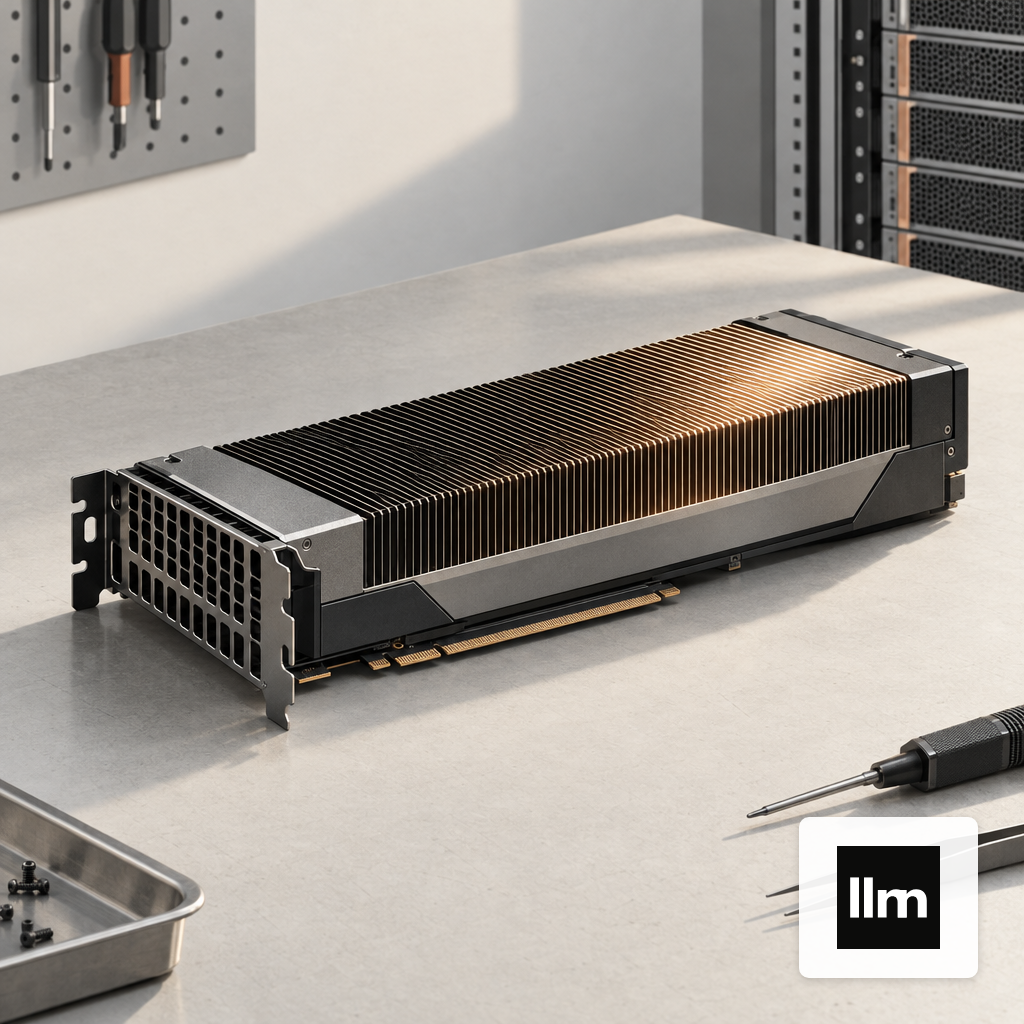
Total parameters, not active, decide weight memory. At BF16, Qwen3-30B-A3B consumes roughly 60 GB and fits one 80 GB H100 with headroom for KV cache and activations. gpt-oss-120b at native precision needs about 234 GB, meaning tensor parallelism across four H100s or two H200s. OpenAI shipped it with MXFP4 weights by default, which collapses the footprint to approximately 65 GB and places a single-H100 deployment on the table. GLM-4.5-Air lands near 212 GB at BF16 and drops to 55-60 GB under AWQ or Q4 GGUF quantization.
KV cache is the second consumer of HBM. At 128K context under Grouped Query Attention with 32 query heads and 4 KV heads, Qwen3-30B-A3B's per-request KV footprint stays modest. gpt-oss-120b and GLM-4.5-Air carry heavier KV profiles at the same context length. For batched serving, reserve 20-30% of available VRAM for KV, which pushes gpt-oss-120b toward multi-GPU setups even after MXFP4 once concurrency climbs.
The NVIDIA GPU requirements writeup on this site walks through H100, H200 and L40S tradeoffs that shape procurement. The implication for these three: Qwen3-30B-A3B is the only one that comfortably serves one GPU per replica without aggressive quantization.
vLLM and SGLang Both Carry All Three
Current releases of vLLM and SGLang support all three models with expert parallelism, PagedAttention and prefix caching. The broader runtime decision is covered in the vLLM, TensorRT-LLM and SGLang comparison on this site. For these specific models, vLLM's MoE kernels for gpt-oss-120b are more mature because OpenAI contributed the reference implementation, while SGLang tends to win on GLM-4.5-Air agentic workloads thanks to RadixAttention cache reuse across tool-call turns.
Throughput at serving time is driven by active parameters times batch size, plus KV cache pressure. Qwen3-30B-A3B's 3-billion active footprint sustains the highest tokens-per-second per GPU at modest batch sizes. gpt-oss-120b benefits most from batching because its larger total memory amortizes across concurrent requests. GLM-4.5-Air falls between them, with longer prompts favoring SGLang and short bursty requests favoring vLLM's continuous batching. Expert parallelism across GPUs becomes cost-effective above the batch size where expert activation imbalance drops below 10%.
| Specification | Qwen3-30B-A3B |
|---|---|
| Total parameters | 30.5B |
| Active parameters per token | 3B |
| Transformer layers | 48 |
| MoE experts (total) | 128 |
| Experts activated per token | 8 |
| Query heads (GQA) | 32 |
| Key/value heads (GQA) | 4 |
| Native context length | 32,768 |
| Extended context via YaRN | 131,072 |
Benchmarks Favor Different Workloads
Benchmark scores for sparse MoE models need careful reading because active-parameter counts differ, but the reported numbers are informative. OpenAI reports gpt-oss-120b at high reasoning effort with distinctive strength on AIME 2025 and SWE-bench Verified, delivering performance in the range of a dense 70-billion-parameter model at a fraction of the serving cost.
GLM-4.5-Air was optimized for agentic and coding workloads. Z.ai reports results within range of larger commercial systems on tool-use benchmarks, and a 128,000-token context window supports the multi-turn agent traces that justify its higher active-parameter budget. Pre-training allocated 15 trillion tokens of general content plus an additional 7 trillion focused on code and reasoning.
Qwen3-30B-A3B leans on Alibaba's dual thinking and non-thinking mode training and is the strongest general-purpose candidate at its active-parameter class. Its 32,768-token native context extends to 131,072 via YaRN rope scaling, and 32 query heads against 4 KV heads under GQA keep decode-time memory bandwidth tractable.
Licensing Decides the Procurement Story
Licensing is where the comparison becomes a procurement decision. GLM-4.5-Air ships under the MIT license. Qwen3-30B-A3B ships Apache 2.0. OpenAI released gpt-oss-120b under Apache 2.0 as well, with explicit permission for commercial redistribution and derivatives.
Jurisdiction and provenance matter for regulated buyers. Qwen originates with Alibaba Cloud in Hangzhou. Z.ai (formerly Zhipu AI) is based in Beijing. OpenAI is US-based. Organizations with CMMC or ITAR obligations, or HIPAA and GLBA audits that prefer US-governed model lineage, often default to gpt-oss-120b on that basis alone. The weights behave similarly across the three on most enterprise prompts; the paper trail is what differs. For buyers without that constraint, GLM-4.5-Air's MIT license is the most permissive of the three, and the Apache 2.0 posture of Qwen3-30B-A3B is sufficient for almost every commercial use case short of weapons systems.
What Decides the Pick
The decision resolves quickly once the workload is pinned down. A 100-user internal chat and RAG deployment on a single H100 node: Qwen3-30B-A3B. Agentic workflows with heavy tool calling and long multi-turn traces: GLM-4.5-Air. Reasoning-heavy enterprise tasks where capability per token outweighs serving cost, served at MXFP4 on a single H100: gpt-oss-120b.
Teams moving from model selection to a deployed system can engage custom LLM deployment services for the inference stack, monitoring and audit configuration, or take delivery of a pre-racked LLM appliance where the hardware and runtime arrive tuned.
The question worth putting to any vendor proposing one of these three: what is tokens-per-second-per-GPU for the organization's actual prompt-length distribution at the batch concurrency the workload generates? A good answer names the runtime and version, the quantization format, measured KV-cache occupancy, and a latency-versus-concurrency curve. A screenshot of a leaderboard score is not an answer.
Timothy Carter is the Chief Revenue Officer. Tim leads all revenue-generation activities for marketing and software development activities. He has helped to scale sales teams with the right mix of hustle and finesse. Based in Seattle, Washington, Tim enjoys spending time in Hawaii with family and playing disc golf.

Qwen3Guard, WildGuard, and gpt-oss-safeguard Benchmarked for Self-Hosted Deployments

Qwen3 Embedding, BGE, and Voyage Nano Compared for Private RAG

vLLM vs TensorRT-LLM vs SGLang for Production Inference

Pinecone, Qdrant, Weaviate, and pgvector Compared for Private RAG

Private LLM vs ChatGPT Enterprise on Cost, Security and Performance

Deployable Intelligence: Private LLMs for Air-Gapped Environments
Bringing AI in-house, the right way.
Talk through your private or on-prem LLM deployment with an expert who has shipped them in regulated environments.
Private AI, in your inbox.
Occasional, high-signal notes on enterprise LLM deployment, security, and model strategy. No spam.